


Complete the form below so we can contact you directly today.
Secondary School English Tuition in Singapore
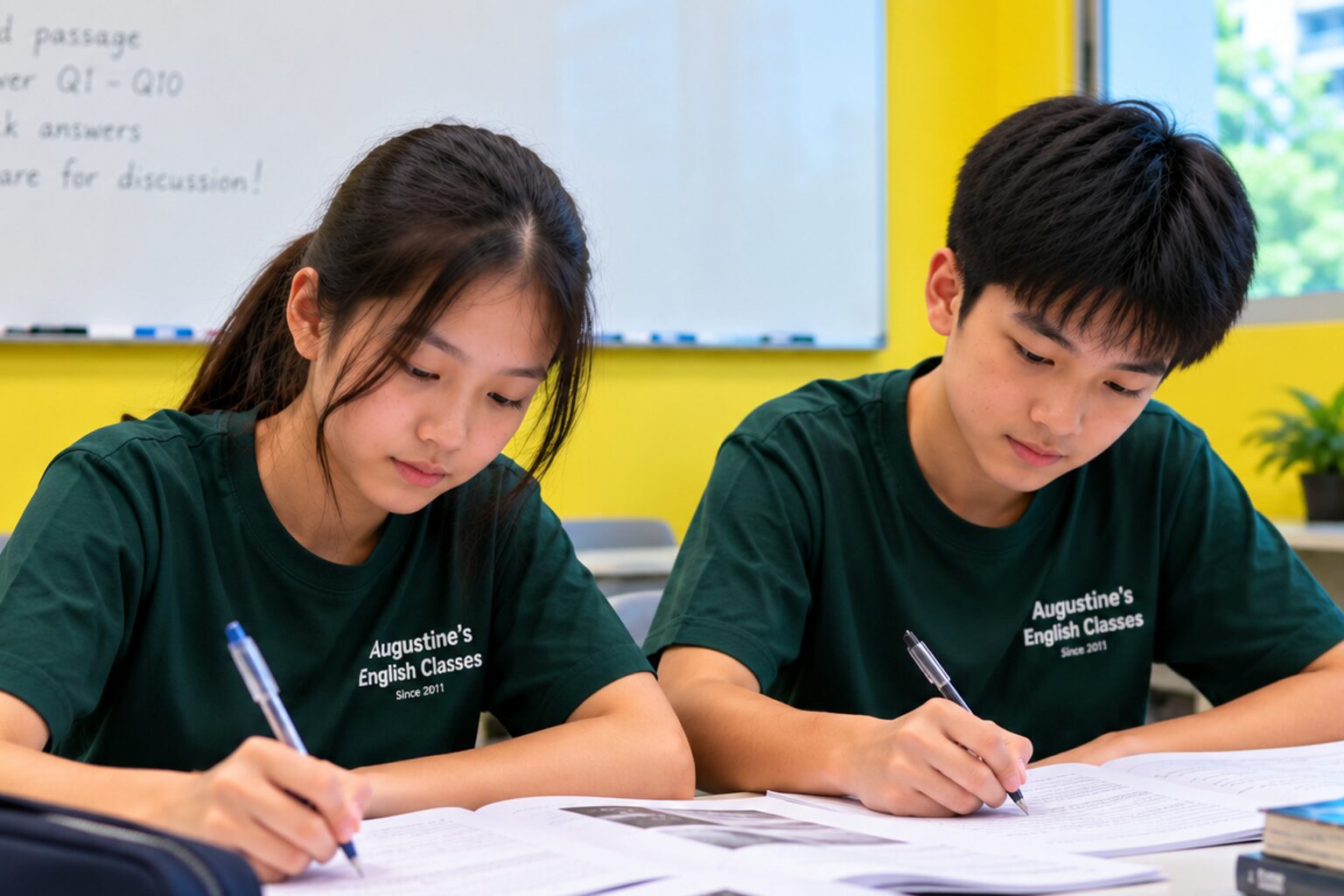
Augustine's English Classes is a secondary English tuition centre in Marine Parade, built on one idea. Marks come from method, not memorisation. Teacher Augustine plans and teaches every lesson personally, drawing on 20+ years of experience guiding Singapore students through PSLE, O-Level, and A-Level English.
Most students don't lose marks over weak vocabulary or thin ideas. They lose marks because no one has shown them how marks are actually awarded.
Our secondary English tuition fixes that, one exam paper at a time.
Preparing for the O-Level English Paper
The O-Level English paper rewards precision. A student can write a fluent, well-argued script and still score C5 to B3, because the answers don't match what assessors are trained to credit.
That's why grade improvement starts with understanding how marks are given.
In our secondary English tuition, students first learn where they usually lose marks. Then, they practise the exact answering formats built for each paper.
Secondary 1 and 2 Coverage
Sec 1 and Sec 2 are the transition years, where students move from primary-style answering into secondary-level rigour.
- Writing. Fixed structures for situational writing such as emails, reports, and speeches, plus planning frameworks for narrative and expository essays
- Comprehension. Methods for unpacking question stems and phrasing answers to secure full marks
- Listening. Note-taking techniques for single-exposure audio, focused on picking out key information
- Oral Communication. Structured response frameworks for reading aloud and spoken interaction
Explore our Secondary 1 English tuition and Secondary 2 English tuition programmes for level-specific detail.
Secondary 3 and 4 Coverage
By Sec 3 and Sec 4, the focus shifts from building foundations to exam precision. Students train directly against the O-Level syllabus.
- Writing. O-Level-grade situational writing formats and continuous writing structures, including the most commonly tested argumentative and expository frameworks
- Comprehension. Techniques for inference questions, language-use questions, and summary, where most students lose 4 to 6 marks unnecessarily
- Listening. Full-paper practice under timed conditions, with focus on graphic organiser questions
- Oral Communication. Response methods for the video stimulus and discussion segment
Key Learning Objectives for Secondary School English Tuition
Augustine's English Classes is a secondary english tuition centre in Singapore focused on three core objectives:
01
Train students to plan before they write, using fixed composition structures that develop content with clarity, relevance, and depth.
02
Train students to unpack each comprehension question stem and phrase answers in the form examiners credit.
03
Train students in a step-by-step summary method — identifying points, paraphrasing accurately, and staying within the word limit.
Unlocking O-Level Exam Success with Our Secondary English Tuition
Our Secondary School English Tuition Approach to Tackling the O-Level English Paper
O-Level success isn't built through last-minute cramming. It comes from a full shift, moving from primary-style answering to the discipline the upper-secondary syllabus demands. We build that discipline gradually, starting in Sec 1 and carrying it through to the O-Level year.
Moving from primary to secondary English is a big jump. Comprehension questions demand more inference. Compositions are judged on control, not just ideas. Methods that worked for PSLE no longer earn marks. Our approach rebuilds each paper from the ground up.
Paper 1
Paper 1: Situational and Continuous Writing

Scripts are marked on content, language, and organisation, and most marks slip away in organisation, not vocabulary. Students train on the following.
- Format conventions for each situational writing type, including email, report, speech, and article
- Planning frameworks for argumentative, expository, and narrative essays
- Editing drills targeting the grammar and vocabulary errors that recur most in lower-scoring scripts
Paper 2
Paper 2: Comprehension
Comprehension and summary make up most of Paper 2's marks, and students usually underperform on language-use questions. In class, students learn the following.
- Question types are broken down by type, including literal, inferential, vocabulary-in-context, and language use
- A three-part method is taught for language-use questions, rarely covered explicitly in school
- Summary technique follows a fixed identify-then-paraphrase structure to fit the word limit
Paper 3
Paper 3: Listening Comprehension
Paper 3 rewards structured listening, not memory. Students train on the following.
- Note-taking for single-exposure audio, built around structural cues
- How multiple-choice and graphic organiser questions are usually set
- Spotting close-distractor options, the biggest source of lost marks here
Paper 4
Paper 4: Oral Communication
Oral marks plateau fast when answers are short or unstructured. Students train on the following.
- Reading aloud with controlled pacing, stress, and intonation
- A four-part framework for the video stimulus, covering observe, interpret, respond, and justify
- Discussion technique for extending a point and handling follow-up questions

What Sets Our Secondary English Tuition Apart
Teacher Augustine teaches every class personally, rather than passing students to junior tutors or rotating between instructors. This allows him to track each student's recurring errors and progress throughout the year.
Class sizes are capped at 8. Every composition is marked individually, and comprehension answers are reviewed against the marking scheme, with feedback provided during the lesson.
Our teaching approach draws on over two decades of experience in English education, focusing on structured thinking, precise answering techniques and independent learning. Many of our students have also received positive feedback from their school teachers on the quality of their written work, particularly their composition writing and answering techniques.
Ready to experience our teaching approach? Sign up for a free trial class.

Streamlined Components, Yet Deeper Understanding
Sec 1 and Sec 2 build the habits of structured answering, clear planning, and controlled writing.
Sec 3 and Sec 4 sharpen those habits into O-Level precision, where comprehension calls for inference and evaluation rather than just retrieval, and compositions need a clear stance rather than a rehearsed structure.
Our secondary English tuition tracks that shift at every level.

Why Choose Our Secondary English Tuition
Master every paper. A fixed framework for situational writing, comprehension, summary, and oral response, so answers match how marks are actually awarded
Learn in small groups. Classes are capped at 8 students, with direct correction and consistent progress tracking rather than generic feedback
Build stronger communication. Structured writing and oral training help students express ideas clearly, in exams and beyond
See measurable results. 82% of students improve by at least 2 grades within 6 to 9 months, with many moving from C or D grades to A1 or A2 distinctions
Replace guesswork with method. Students stop relying on instinct and start applying technique, the foundation for consistent exam performance
Learn from one dedicated teacher. Every lesson is planned and taught personally by Teacher Augustine, so recurring mistakes get tracked and corrected by the same person all year
Train close to home. Learn at our english tuition centre in Marine Parade, with terms running continuously through the year so students can join at the start of any term

Tuition Fees For Our Secondary English Tuition
Each class is capped at 8 students and priced $100 per 2-hour lesson. Our classes are taught personally by Augustine, allowing for close correction and consistent tracking of individual progress throughout the term.
Term Schedule and Fees
Term | Dates | Lessons | Secondary Fee |
Term 1 | 24 Nov 2025 – 22 Feb 2026 | 13 | $1,300 |
Term 2 | 23 Feb – 17 May 2026 | 12 | $1,200 |
Term 3 | 1 Jun – 16 Aug 2026 | 11 | $1,100 |
Term 4 | 17 Aug – 25 Oct 2026 | 10 | $1,000 |
Augustine's Approach to Secondary School English Tuition
Most students find English frustrating not because they lack ability, but because the subject feels unpredictable: high effort, inconsistent results. Our approach removes that unpredictability through three teaching principles refined over two decades.

Pattern Recognition Over Rote Memorisation
English exams test whether a student can recognise what a question is asking and respond correctly. Students learn to spot the patterns behind each question type, so the same method holds up whether the topic is familiar or completely new. This helps students perform consistently across different papers and topics.

AI as a Tool for Sharper Thinking
AI tools are used where useful to strengthen a student's own thinking. Students might use AI to generate practice questions, check their understanding of a grammar rule, or explore alternative ways to structure an argument. Teacher Augustine guides how students use these tools, and the final writing and judgement remain the student's own.

Learning Reinforced Through Teaching
Students remember a method far better when they can explain it themselves. Throughout the programme, students walk through their own reasoning, covering how they arrived at a comprehension answer or why they structured an essay a certain way. Being able to explain the method is often what turns a technique into a lasting habit.
Easy Registration for Our Secondary English Programme


We’ll contact you to review your child’s learning needs properly.

We’ll place you in the suitable programme for your trial lesson.

My son joined Augustine’s English Classes after PSLE as his English results were quite weak, and we were worried about the transition to secondary school.
After a few months with Teacher Augustine, we could already see a big improvement in the way he handled comprehension and writing questions. He became much more confident and knew how to answer with better precision instead of simply guessing.
We were honestly very surprised when he scored an A1 for his first Sec 1 WA.
Teacher Augustine is very experienced and teaches in a very clear and systematic way. The students are pushed to think properly and understand how to approach questions, which made a big difference for my son.

Vanessa Tay
My daughter started attending Augustine's English Classes in January of this year. I'm glad that her English has improved significantly, especially her composition. Her confidence in learning English has also increased. Teacher Augustine has a unique way of teaching and encouraging students. My daughter is very motivated and enjoys his classes. The classroom environment is comfortable, and there is a little entertainment before class for students to decompress. I am extremely pleased with my decision to choose this tuition centre for my daughter's education.
C M Lim
Mr Augustine is a passionate teacher who teaches from the heart and strives to help students reach their full potential. His lessons are fun and interesting. He tries to keep his classes small so that he attend to each and every student's query. My son really enjoys his lessons and look forward to attending his classes. Most of all I can see great improvement in his grades.
Joanne Lin
Augustine makes his lessons fun and enjoyable he gives us really great exam tips and managed to pull up my English grades
Xavier Lim
I feel very blessed to have found Augustine's English tuition centre.
The enrolment is fuss free. There is no deposit or complicated terms and conditions to confuse busy parents like me.
My gal has been with this centre since P6 in 2019 till now. She is more than willing to travel from south all the way to the East to attend Augustine's English classes and without fail. She finds him very engaging and motivating enough to keep her interest in learning English going and to the extent that she fills up her bookshelf with English storybooks, using her own pocket money. She has smoothly progressed to sec 4 now, with consistent good score in English. If my gal manages to go to JC next year and if there is still English tuition class open for JC level, she will definitely continue her tuition in this centre! Keep going, Augustine!
Elise Teo
My children’s grades improved significantly due to the fun and engaging teachings. Augustine is encouraging and my children look forward to their classes every time. Highly recommended.
Angelene Tan


FAQ
School lessons mostly assume technique develops through practice alone. Our classes teach it directly. Taught personally by Teacher Augustine at our Marine Parade centre, students learn the exact framework for each component, in small groups of up to 8, with correction given in the same lesson.
Most students do best starting in Sec 1 or Sec 2, before old habits set in. Terms run continuously through the year, so students can join at the start of any term. Sec 3 and Sec 4 students who join later can still see real improvement if they apply the structures consistently.
Yes. Many students join with E8 or F9 grades. A failing grade usually means the student hasn't been taught a clear method, not that they lack ability. Improvement is usually measurable within one to two terms.
Exam anxiety usually comes from not knowing the method, not from a lack of ability. Once students know how to approach each question type, what to identify, how to structure the response, and how marks are awarded, the uncertainty goes away. Regular timed practice closes the gap between practice performance and exam-day performance.
Most students improve by at least 2 grades within 6 to 9 months, with many moving from C or D grades to A1 or A2 distinctions by their O-Level year. The exact timeline depends on where the student starts and how consistently they apply what they learn.

Ready to kickstart your
child’s journey to success?
Would You Like Your Child To Be Our Next Success Story?
Simply fill in your particulars and we will contact you to confirm the FREE Trial Class!
As featured on:


