


PSLE Composition Rescue Handbook 2026: A Practical Guide for Students
Many Primary 6 students do not struggle with PSLE composition because they cannot write.
They struggle because they see the topic and pictures, then do not know what story to create.
Once that happens, valuable examination time is lost. Some students force a memorised story into the question. Others spend too long inventing an elaborate plot. Some begin writing without knowing how their story will develop or end.
A better approach is to use a simple structure that can be applied to almost any PSLE Continuous Writing topic.
After reviewing the recurring demands of past PSLE composition questions, I developed this planning formula:
TOPIC → PICTURE → PROBLEM → CLIMAX → SOLUTION → TOPIC
This is the core of the PSLE Composition Rescue Formula.
The method is designed to help students generate a relevant story quickly, organise it clearly and avoid the common problem of drifting away from the topic.
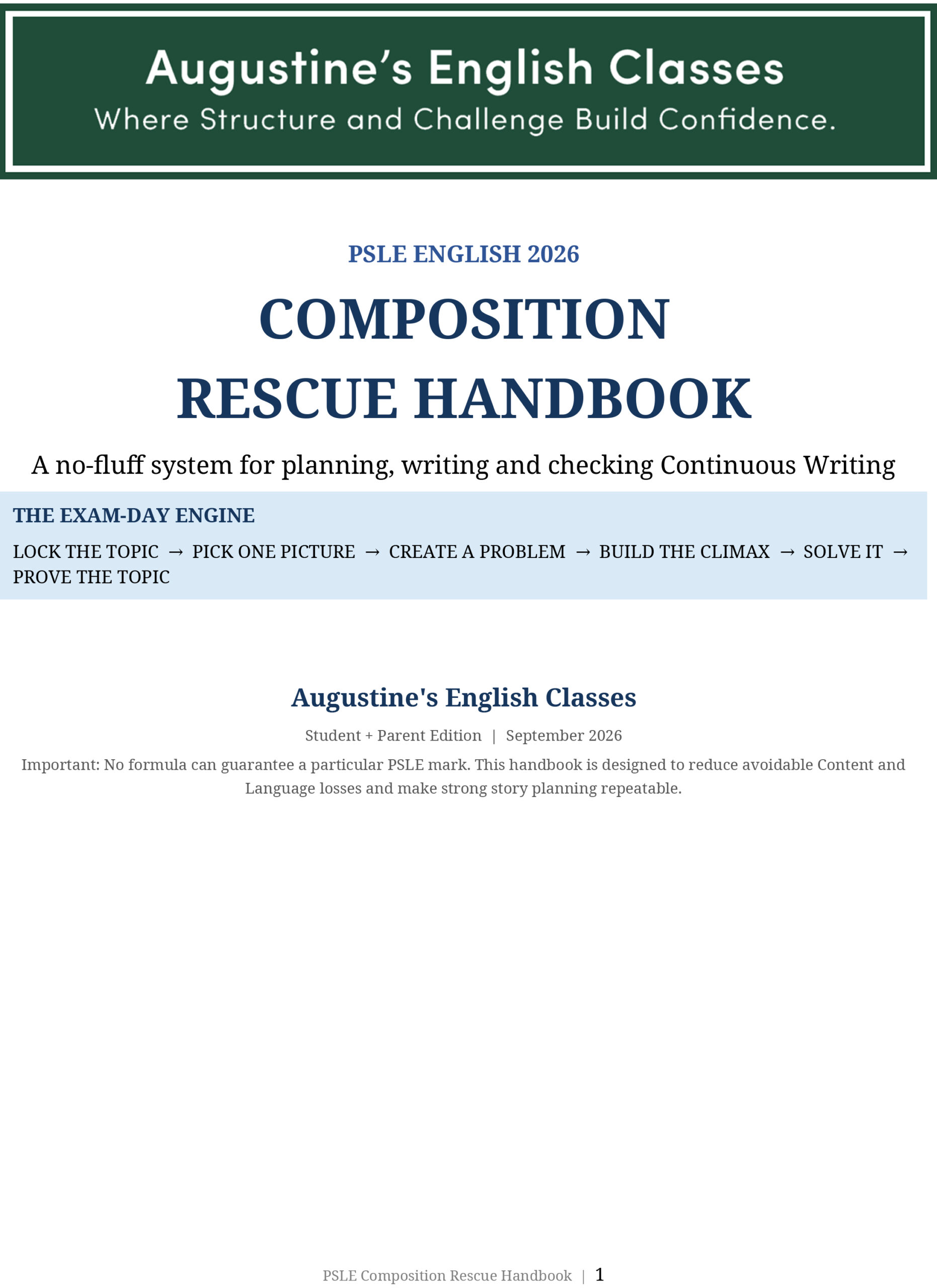
I have compiled the full system into a free 20-page handbook for Primary 6 students and parents. You can download it below, or continue reading for a practical explanation of how the formula works.
Download the Free PSLE Composition Rescue Handbook
The handbook contains the complete planning formula, practical writing techniques, worked examples, revision drills, parent coaching questions and an examination-day checklist.
Suitable for: Primary 6 students preparing for PSLE English
Why Students Get Stuck During PSLE Composition
PSLE Continuous Writing does not require students to produce an extraordinary story.
The more important challenge is to write a composition that is clearly relevant to the topic, properly developed, logically organised and expressed accurately.
Students commonly lose control in a few predictable ways:
- They spend too long trying to invent an impressive plot.
- They force a memorised story into a topic that does not fit naturally.
- They mention the topic at the start but gradually write away from it.
- They spend too much time on the introduction and rush the climax and ending.
- They make the plot unnecessarily dramatic and lose control of their language.
The solution is not to memorise more complete compositions.
Students need a repeatable method for generating a relevant story under examination pressure.
The PSLE Composition Rescue Formula
When a student has no immediate idea what to write, use these six steps.
Step 1: Lock the Topic
Before thinking about characters, vocabulary or dramatic events, ask:
What must my story prove?
This is different from simply mentioning the topic.
If the topic is Being Thankful, writing about receiving a present is not enough. The story should show why the character feels thankful and how that gratitude is demonstrated.
If the topic is Teamwork, several characters merely appearing together is not enough. They must actually cooperate towards a common goal.
If the topic is A Promise, a promise should not simply be mentioned. It should matter to the events of the story and usually be tested in some way.
A useful test is:
If I remove the topic from my composition, does the story still work?
If the answer is yes, the topic may not be central enough.
Step 2: Choose One Useful Picture
Students do not need to force every picture into the composition.
Start with the picture that gives you the clearest and most manageable story idea.
More importantly, do not simply mention the picture. Give it a purpose.
Weak:
There was a trophy on the table.
Stronger:
Winning the trophy became our team's goal after several disappointing competitions.
In the second example, the picture is no longer decoration. It has become part of the plot.
The same principle applies to any picture provided in the examination.
The question is not:
How can I squeeze this picture into my story?
The better question is:
How can this picture make something happen?
Step 3: Ask the Rescue Question
If the student is still stuck, ask one question:
WHAT COULD GO WRONG?
This creates conflict, and conflict gives the story somewhere to go.
The problem does not need to involve a fire, serious accident, ambulance or police report.
In fact, smaller problems are often easier to develop convincingly.
Useful problems include:
- a disagreement
- a misunderstanding
- a temptation
- a mistake
- fear
- embarrassment
- failure
- impatience
- an unexpected delay
- a forgotten responsibility
These situations can be adapted to many different PSLE topics.
A disagreement can become a story about teamwork. A temptation can test a promise. Fear can drive a story about trying something new. A mistake can lead to a change for the better.
Step 4: Build Towards the Climax
The climax should not simply be the loudest or most dramatic moment in the composition.
It should be the moment when the topic matters most.
Ask:
What must the character do, choose or realise?
For a story about a promise, the climax may be the moment the character decides whether to keep it.
For teamwork, it may be the moment the characters stop arguing and finally cooperate.
For trying something new, it may be the moment the character chooses whether to give up or confront a fear.
For being thankful, it may be the moment the character finally understands what someone else has done for him or her.
This gives the climax a clear purpose.
Step 5: Develop the Solution
Once the climax occurs, show what happens because of it.
A common weakness is resolving the problem too quickly.
Weak:
Fortunately, we found the wallet. I was very happy.
Stronger:
I spotted the corner of the wallet beneath the bench and rushed towards it. After checking that nothing was missing, Dad finally released the breath he had been holding.
The solution does not need to be long.
It simply needs enough development to make the outcome believable and complete.
Step 6: Return to the Topic
The conclusion is the student's final opportunity to prove relevance.
A generic ending such as:
It was a day I would never forget.
does very little to strengthen the composition.
Instead, return naturally to what the story was actually about.
For example, for Trying Something New:
I had entered the hall terrified of trying something unfamiliar. I left wondering why I had been so afraid in the first place.
The examiner should finish the composition with no doubt about how the story addresses the topic.
The 5-Part Story Structure
Once the idea has been generated, students can organise it using a straightforward five-part structure.
- Introduction — establish the situation and introduce the topic.
- Problem — introduce something that makes the situation difficult.
- Climax — the major action, decision or realisation.
- Solution — show the consequence and resolve the problem.
- Conclusion — return clearly to the topic.
This structure is deliberately simple.
Under examination conditions, a structure students can remember and execute reliably is more useful than a complicated framework that sounds impressive but is difficult to apply.
The 3 Topic Touches
One useful technique can prevent students from drifting away from the question.
Make the topic visible at three important points in the composition.
- Introduction: establish the topic.
- Climax: test or demonstrate it.
- Conclusion: confirm why it mattered.
Consider a story about Being Thankful.
Introduction: Mrs Wong stays behind every week to help the narrator with Mathematics.
Climax: the narrator discovers that Mrs Wong has repeatedly missed her usual bus home in order to provide the extra help.
Conclusion: the narrator finally understands the sacrifice and finds a meaningful way to express gratitude.
The topic now runs through the entire story rather than appearing only at the beginning or end.
Do Not Waste the Introduction
Another common weakness is an introduction that becomes disproportionately long.
Students may spend several paragraphs describing the weather, waking up, eating breakfast or travelling somewhere before the actual story begins.
This creates two problems.
First, valuable examination time is lost.
Second, the sections that matter most — the problem, climax and solution — are rushed.
The middle of the story should carry more weight than the introduction.
Set up the situation clearly, then move into the meaningful event.
Build an Event Bank, Not a Story Bank
Students are often encouraged to memorise full compositions.
This can become risky when the actual examination topic does not match what they have memorised.
A more flexible method is to build a small bank of reusable situations:
- disagreement
- misunderstanding
- temptation
- fear
- mistake
- lost object
- minor accident
- unexpected delay
- failure
- forgotten responsibility
These are not complete stories to reproduce word-for-word.
They are story engines.
The same event can be adapted differently depending on the topic.
For example:
- Teamwork: disagreement → failure → cooperation → success
- A Promise: temptation → difficult choice → promise kept
- Trying Something New: fear → failure → second attempt → progress
- Change for the Better: mistake → consequence → decision to change
This trains flexibility instead of dependence on memorised plots.
Language: Control Before Complexity
A good story idea alone is not enough.
Students still need to express their ideas clearly and accurately.
However, trying to insert difficult vocabulary everywhere can create unnecessary errors.
Prioritise:
- consistent tense
- complete sentences
- subject-verb agreement
- clear pronoun references
- accurate dialogue punctuation
- precise verbs
- controlled sentence variety
Use stronger vocabulary when it improves meaning.
Do not use a difficult word simply because it sounds impressive.
Control first. Sophistication second.
Use Precise Verbs Instead of Forcing Fancy Vocabulary
One of the easiest ways to improve writing without making it unnatural is to choose stronger verbs.
For example:
Less precise: She walked quickly towards the gate.
More precise: She hurried towards the gate.
Less precise: He said loudly.
More precise: He shouted.
Less precise: I looked carefully at the envelope.
More precise: I examined the envelope.
Precision improves writing more reliably than inserting complicated phrases that the student cannot fully control.
A 5-Minute Planning Method
Before writing, students can create a simple plan using keywords.
TOPIC
What must my story prove?
PICTURE
Which picture will actually matter?
INTRODUCTION
Who? Where? What is happening?
PROBLEM
What goes wrong?
CLIMAX
What must the character do, choose or realise?
SOLUTION
What happens because of it?
CONCLUSION
How does the ending prove the topic?
The plan should be written in keywords, not complete sentences.
The purpose is to prevent the student from starting a composition without knowing where the story is going.
A Simple Development Rule
Students often spend too many words setting up the story and too few words developing the important events.
A useful emergency rule is to give the key sections enough space.
At minimum, aim to develop the:
- Problem
- Climax
- Solution
with more than a single rushed sentence each.
The reader should be able to understand:
what went wrong → what the character did → what happened because of it.
How Parents Can Practise This at Home
Parents do not need to mark complete compositions in order to reinforce the method.
Instead, give your child a topic and ask six questions:
- What must this story prove?
- Which picture would you choose?
- What could go wrong?
- What is the climax?
- How is the problem solved?
- How will your ending return to the topic?
The child should be able to produce a workable story plan in approximately five minutes.
If the plan is weak, do not immediately supply the answer.
Ask a more specific question.
For example:
- Why does this problem matter?
- What choice does the character have to make?
- How does this connect back to the topic?
- What changes after the climax?
This teaches the child to think through the story rather than wait for an adult to create it.
A Better Way to Revise Past PSLE Topics
Students do not need to write a full composition for every practice topic.
A more efficient revision method is to practise the planning stage repeatedly.
For each topic:
TOPIC → PICTURE → PROBLEM → CLIMAX → SOLUTION → CONCLUSION
Spend approximately five to seven minutes creating the plan.
Then move to the next topic.
After several plans have been completed, choose the strongest ones and turn those into full timed compositions.
This develops the skill students actually need when an unfamiliar question appears: the ability to adapt quickly.
What Students Should Check Before Handing In
Before submitting the composition, use a short final check.
Content Check
- Is my story clearly about the exact topic?
- Did I use at least one picture meaningfully?
- Did I address the guiding questions?
- Is there a clear problem?
- Does the climax involve an important action, choice or realisation?
- Does the conclusion return to the topic?
Language Check
- Is my tense consistent?
- Are my sentences complete?
- Have I checked subject-verb agreement?
- Is my dialogue punctuated correctly?
- Are my pronouns clear?
- Have I corrected obvious spelling and punctuation errors?
A short, focused check is far more useful than rereading without knowing what to look for.
Download the Complete PSLE Composition Rescue Handbook
The free 20-page handbook contains:
- the complete PSLE Composition Rescue Formula
- the 3 Locks planning method
- the 5-part story structure
- a reusable problem bank
- climax and ending techniques
- language and editing checks
- worked planning examples
- short revision drills
- parent coaching questions
- a student planning sheet
- an examination-day checklist
Final Advice for PSLE Composition
Students do not need an amazing story every time.
They need a story that is relevant, developed, controlled and complete.
If you become stuck during the examination, return to the Rescue Formula:
TOPIC → PICTURE → PROBLEM → CLIMAX → SOLUTION → TOPIC
Lock the topic.
Choose one useful picture.
Create a manageable problem.
Build towards a meaningful climax.
Resolve the problem properly.
Then return to the topic.
Simple does not mean weak.
A simple story that is relevant and well developed is safer than an ambitious story that becomes confusing, unrealistic or difficult to control.
About Teacher Augustine
Teacher Augustine is the principal tutor of Augustine's English Classes in Marine Parade, Singapore. He personally teaches Primary, Secondary and JC English, with lessons focused on structured thinking, comprehension and writing techniques that students can understand, practise and eventually apply independently.
